
Vehicle damage assessment after an accident: What you need to know after a traffic accident
10
Jun
Vehicle damage assessment after an accident: What you need to know after a traffic accident
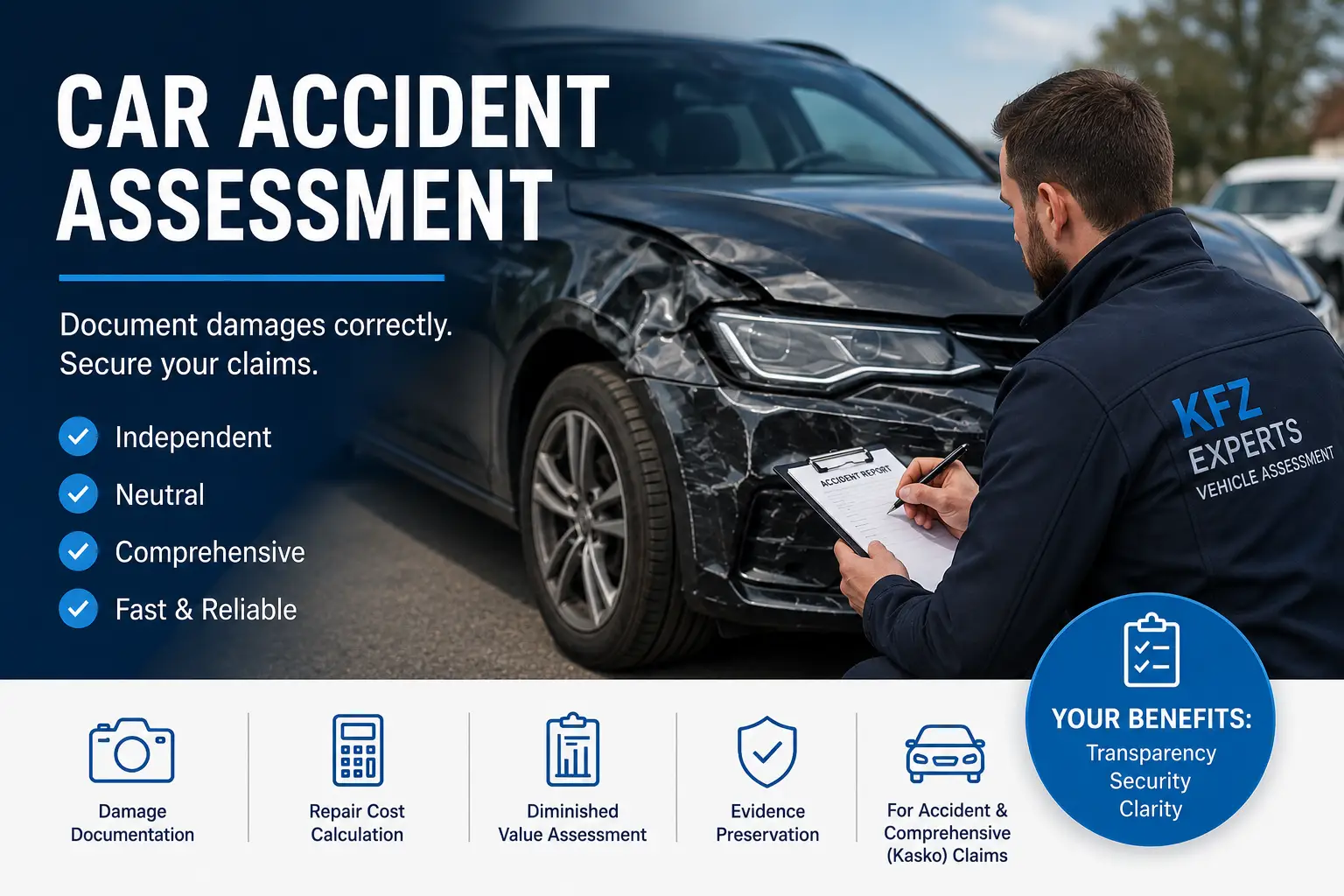
After an accident, a vehicle damage report helps to document damage, repair costs, and potential depreciation in value in a transparent and comprehensible way. This article explains when an accident damage report is advisable, how the process works, and what vehicle owners should pay attention to.
After a traffic accident, many vehicle owners initially face the same questions: How extensive is the damage really? Is a cost estimate sufficient? Does the insurance company need to be informed? And when is an independent vehicle appraisal advisable after an accident? Especially in this situation, clear and comprehensible documentation is crucial so that damage, repair costs, and potential depreciation are professionally recorded.
An accident report helps to objectively assess the condition of the vehicle after the damage. This includes not only visible body damage, but also hidden damage, technical consequences, the replacement value, the salvage value, and any potential depreciation, all of which can play an important role depending on the extent of the damage. A professionally prepared report can provide greater clarity, especially in cases of liability claims, comprehensive insurance claims, or later disputes with the insurance company.
For vehicle owners, it is therefore important not to act rashly after an accident. Those who have the damage repaired before it has been fully documented risk potentially missing crucial evidence. An independent automotive expert can inspect the damage, document it photographically, and summarize the relevant technical and economic aspects in an expert report.
This article explains when a vehicle appraisal is useful after an accident, what information an accident report contains, how the process works, and what you should pay attention to regarding evidence preservation, repair confirmation, and follow-up inspections.
What is a vehicle damage assessment after an accident?
A vehicle damage report following an accident is a technical report that objectively documents the condition of a vehicle after an incident. It is usually prepared by a certified vehicle expert and serves to record the damage in a comprehensible manner. This includes not only visible damage to the bodywork, paintwork, or attachments, but also potential technical consequences that are not always immediately apparent.
The central focus of an accident report is to determine the extent of the damage caused by the accident and what measures may be necessary for proper repair. This includes, among other things, photographic documentation of the damage, a description of the damaged components, a calculation of the anticipated repair costs, and an assessment of other relevant values. Depending on the case, the replacement value, the salvage value, the repair time, and any potential depreciation may also be considered.
Such an expert report can be particularly important if the damage exceeds minor wear and tear or if the exact extent of the damage is not immediately apparent. An independent assessment can also be helpful for newer vehicles, leased vehicles, high-end models, or vehicles with pre-existing damage, in order to accurately determine the vehicle's actual condition.
It's important to understand that a vehicle damage report is more than just a simple breakdown of repair costs. While a cost estimate is usually limited to the anticipated repair costs, an accident report takes a more comprehensive look at the damage. It can provide additional information that may be relevant for dealing with the insurance company, for the repair shop, for a lawyer, or for later evidence preservation.
Especially after a traffic accident, a professionally prepared expert report provides greater transparency. Vehicle owners receive a comprehensible basis for better assessing the damage, potential consequential costs, and the further course of action.
When is an accident report advisable?
An accident report is always advisable when the damage to the vehicle cannot be clearly classified as minor or when the actual extent of the damage can only be reliably assessed through a professional inspection. After a traffic accident, some damage may initially appear harmless, but upon closer inspection, it can have further consequences. Deformations of load-bearing components, damage to sensors, driver assistance systems, axle components, or vehicle electronics are not always immediately visible from the outside.
Especially in the case of an accident that was not your fault, an independent vehicle appraisal can be helpful in objectively documenting the damage. The appraisal can clearly present the repair costs, the replacement value, the salvage value, the estimated repair time, and any potential depreciation in value. This information can be relevant later on when dealing with the insurance company, the repair shop, or a lawyer.
Even with newer vehicles, leased vehicles, or high-end models, the damage should not be underestimated too quickly. Even minor accident damage can affect the vehicle's value. A professional accident report helps to better assess the technical and economic extent of the damage.
An accident report can be useful in the following situations, for example:
If the damage goes beyond a small scratch or a slight dent
If the repair costs cannot be clearly estimated
If a decrease in value is possible
If the vehicle is leased, financed, or relatively new
If a high-value or commercially used vehicle is affected
If technical damage cannot be ruled out
If there are uncertainties regarding the course of the accident or the amount of damage
If evidence is needed for further regulation
A vehicle expert doesn't just superficially examine the damage, but also considers the connections between the accident, visible damage, and potential technical consequences. This creates a comprehensible basis for further decisions: repair, settlement, follow-up inspection, or, if necessary, additional technical testing.
Anyone unsure whether an expert report is necessary should have the damage professionally assessed before any repairs. Once the vehicle has been repaired, important evidence and documentation can be lost. An early assessment therefore provides greater clarity and can help avoid later disputes.
Liability claim and comprehensive insurance claim: What is the difference?
After a traffic accident, it's important to distinguish between a third-party liability claim and a comprehensive insurance claim. While both involve vehicle damage, the procedures with the insurance company and the role of a vehicle appraisal can differ significantly. This classification is crucial for vehicle owners to correctly understand the subsequent process.
Liability claim
A liability claim typically arises when another road user has caused an accident and their motor vehicle liability insurance is to cover the resulting damage. In this case, it is important to document the damage to your own vehicle objectively and comprehensibly. An independent accident report can help to determine the extent of the damage, the necessary repairs, any potential depreciation in value, and other relevant factors.
Especially in liability cases, careful documentation of evidence is crucial. The expert report can serve as a technical basis when claiming damages from the opposing insurance company. This involves examining not only which components were damaged, but also whether the identified damage is plausible in relation to the described accident sequence.
Comprehensive insurance claim
Comprehensive insurance claims, on the other hand, refer to damage to your own vehicle that can be covered by your own partial or full comprehensive insurance. This can be relevant, for example, in the case of accidents you cause yourself, damage caused by wild animals, hail damage, vandalism, fire, or water damage. The specific services covered always depend on the individual insurance contract and the agreed-upon terms and conditions.
Even in the case of comprehensive insurance claims, a vehicle appraisal can be useful if the extent of the damage is unclear, technical consequences need to be assessed, or precise documentation is required. In some cases, the insurance company prescribes specific procedures or commissions its own assessment. Nevertheless, an independent evaluation can provide additional transparency, especially if there are questions regarding repairs, the cause of the damage, or the vehicle's value.
The most important difference, therefore, lies in which insurance company handles the claim and what specific entitlements exist. While liability claims often involve the other party's insurance, comprehensive insurance claims are handled by the policyholder's own insurance. In both cases, a professionally prepared expert report can help to document the damage clearly and better assess the next steps.
What information does an accident report contain?
An accident report summarizes all relevant information that may be important for the technical and economic assessment of vehicle damage. The exact scope always depends on the individual case, the nature of the damage, and the purpose of the report. However, the report should generally provide a comprehensible basis for better assessing the damage, repair costs, and any further consequences of the accident.
The process begins with recording general vehicle data. This includes, among other things, the make, model, date of first registration, mileage, vehicle identification number (VIN), equipment, and the vehicle's overall condition. This information is important because it forms the basis for the subsequent assessment. Identical damage can be assessed differently depending on the vehicle's age, mileage, equipment, and market value.
A key component is the photographic and technical documentation of the damage. The automotive expert records which areas are damaged, which components may be affected, and whether there are any indications of hidden damage. In addition to body and paint damage, technical components such as axle parts, sensors, driver assistance systems, lighting, electronics, and safety-relevant components can also be considered.
Furthermore, an accident report typically includes a calculation of the anticipated repair costs. This can encompass spare parts, labor, painting, necessary ancillary work, and other repair items. The aim is to present the effort required for a professional repair in a transparent and comprehensible manner.
Depending on the specific damage case, further values and information may also be included in the expert report:
Replacement value of the vehicle
Residual value in case of severe damage or total economic loss
Potential depreciation in value after the accident
Estimated repair time
Loss of use or downtime
Indications of prior damage or old damage
Plausibility check of the damage pattern
Technical assessment of hidden or potential consequential damages
It is particularly important to distinguish between accident-related damage and pre-existing damage. Not every visible defect is necessarily related to the current accident. A carefully prepared expert report therefore examines whether the damage pattern corresponds to the described accident sequence and which damages can actually be attributed to the current event.
An accident report is therefore more than just a cost breakdown. It comprehensively documents the vehicle's condition after the accident and can be relevant for the insurance company, the repair shop, a lawyer, or for later evidence preservation. This provides vehicle owners with a clear basis for better planning and more informed decisions.
Why is securing evidence important after an accident?
After a traffic accident, securing evidence can play a crucial role. Immediately after the incident, many traces are still clearly visible: damage to the vehicle, impact marks, paint traces, deformations, fractures, or clues to the accident's sequence of events. If these details are not documented promptly, important information can be lost later, especially if the vehicle has already been repaired, moved, or partially disassembled.
Professional evidence preservation helps to document the vehicle's condition after an accident in a comprehensible manner. This involves more than just taking photos of visible damage. A vehicle expert also examines whether the damage pattern corresponds to the described accident sequence, whether there is any hidden damage, and whether specific damage can be clearly attributed to the accident. This technical assessment can be particularly important in more complex cases.
Securing evidence becomes particularly important if the insurance company later has questions, if there are differing assessments of the damage amount, or if disputes arise regarding the accident's circumstances. An early vehicle damage report can then serve as verifiable documentation. It shows what damage was identified, how it was assessed, and what repair measures may be necessary from a technical perspective.
Even with seemingly minor damage, the importance of documenting evidence should not be underestimated. Modern vehicles are equipped with sensors, driver assistance systems, cameras, control units, and safety-relevant components that can be affected in an accident. Not every technical defect is immediately visible. A professional assessment can help identify such risks early on and better estimate the extent of the damage.
For vehicle owners, careful documentation of evidence primarily means greater clarity. It creates a documented basis for further communication with insurance companies, repair shops, or lawyers and can help avoid later disagreements. Therefore, a vehicle should ideally be inspected after an accident before any repairs are carried out and before any major changes are made to the damage.
Procedure: How a vehicle damage assessment works after an accident
The process of obtaining a vehicle damage report after an accident is usually simpler for vehicle owners than many initially assume. It is particularly important that the damage is assessed as early as possible, before repairs begin or important traces on the vehicle are altered. This allows the vehicle expert to fully assess the condition of the vehicle and accurately document the relevant information.
1. Contact and appointment scheduling
The first step is to contact the vehicle appraisal office. During this process, the most important details about the accident and the vehicle will be recorded. This includes, for example, the time of the accident, the type of damage, the current location of the vehicle, and whether the vehicle is still drivable. Based on this information, a suitable appointment for the inspection can be arranged.
Depending on the situation, the inspection can take place in the workshop, at the vehicle's location, at the vehicle owner's premises, or at one of the two branches. A flexible on-site inspection can be particularly useful if the vehicle is no longer safely roadworthy.
2. Inspection and damage assessment
During the vehicle inspection, the expert examines the visible damage and documents it photographically. This includes recording damaged components, paint damage, deformations, gaps, impact areas, and any possible indications of hidden damage. If necessary, further tests such as paint thickness measurements, visual inspections of technical components, or a review of the vehicle documents may also be carried out.
This step involves more than just photographing the obvious damage. The expert also assesses whether the damage pattern corresponds to the described accident sequence and whether further technical examinations might be necessary.
3. Assessment of the extent of the damage
Following the inspection, the collected information is evaluated. The expert assesses which repairs may be necessary from a technical perspective and what the likely costs are. This includes, among other things, spare parts, labor, painting, and any additional work.
Depending on the specific damage, the replacement value, residual value, potential depreciation, and estimated repair time can also be assessed. This information is particularly relevant if the damage is extensive or if a total loss cannot be ruled out.
4. Preparation of the accident report
The accident report is then prepared. It summarizes the vehicle data, the damage description, the photographic documentation, the repair estimate, and other relevant assessment information in a structured report. The aim is a comprehensible documentation that presents the damage in a technically and economically understandable way.
The scope of the expert report depends on the individual case. For simple damage patterns, the report can be more concise, while complex damage, technical anomalies, or special issues may require a more detailed assessment.
5. Use of the expert opinion in further proceedings
Once completed, the report can be used for further communication with the insurance company, the repair shop, or a lawyer, depending on the situation. It can help to clearly illustrate the extent of the damage, better assess repair decisions, or clarify any open questions regarding the amount of damage.
For vehicle owners, this process offers above all security and guidance. Instead of relying solely on estimates or incomplete information, they receive a professionally documented basis for the next steps after the accident.
What documents should you prepare?
To ensure that a vehicle damage assessment after an accident can be carried out as completely and without unnecessary delays, vehicle owners should have some important documents ready. Not every document is absolutely necessary in every case, but the better the information base, the more accurately the damage can be assessed and documented.
The vehicle documents are particularly important. The registration certificate Part I, often also called the vehicle registration document, contains key information about the vehicle, its initial registration, engine specifications, and other technical data. This information is needed to correctly identify the vehicle and to carry out the valuation on a reliable basis.
All documents related to the accident itself are also helpful. These can include a completed accident report, contact details of the people involved, insurance information, photos of the accident scene, or a police report. If an insurance claim number is already available, this should also be provided.
The following documents and information may be helpful for the assessment:
Vehicle registration certificate Part I / Vehicle registration document
Existing photos of the accident scene or the damage
Accident report or details of the accident
Contact details and insurance information of those involved in the accident
Police records, if the accident was recorded
Insurance claim number, if already available
Previous repair invoices or maintenance records
Information on pre-existing damage or previous accidents
Leasing or financing documents, if the vehicle is leased or financed
Invoices for special equipment, conversions or retrofitted parts
Information about the vehicle's condition before the accident can also be relevant. This includes, for example, pre-existing damage, previous repairs, special equipment, or modifications. This information helps the vehicle expert to better distinguish accident-related damage from pre-existing damage or normal wear and tear.
If not all documents are immediately available, this is often not a problem. The most important thing is to have the damage assessed early, before repairs begin or the damage pattern is altered. Missing information can be provided later, depending on the case. However, good preparation facilitates the assessment and can help ensure that the accident report is prepared quickly and comprehensibly.
Vehicle appraiser or insurance appraiser?
After an accident, many vehicle owners face the question of whether they should hire their own independent vehicle appraiser or whether the insurance company's assessment is sufficient. This question is particularly important because the damage assessment can be a key basis for further claims processing, repair decisions, and potential claims such as diminished value or loss of use.
An insurance assessor is usually commissioned by the insurance company or employed as part of its internal review process. Their task is to assess the damage from the insurance company's perspective and provide the necessary information for claims processing. While this may be sufficient in certain cases, it does not always replace an independent assessment from the vehicle owner's point of view.
An independent automotive expert assesses the damage impartially and documents the vehicle's condition in a comprehensible manner. This assessment considers not only visible damage but also, depending on the specific circumstances, repair costs, replacement value, residual value, repair duration, potential depreciation, and technical factors. An independent appraisal can provide greater transparency, especially when the extent of the damage is unclear or when high repair costs are involved.
Especially in cases of liability claims, where another road user caused the accident, choosing an independent expert can be important for the injured party. However, the specific claims and costs covered always depend on the individual circumstances. Therefore, expert advice, for example from a lawyer, should be sought for any legal questions.
The situation is different with comprehensive insurance claims. In these cases, the claim is handled by your own insurance company, and the terms and conditions of your partial or full comprehensive coverage play a crucial role. Insurance companies may stipulate their own procedures or inspections in such situations. Nevertheless, an additional expert assessment can be beneficial if technical questions remain unanswered, the extent of the damage is unclear, or a second opinion is needed.
The most important difference, therefore, lies in the perspective and purpose of the assessment. While the insurance company examines the damage as part of its claims settlement process, an independent vehicle appraisal serves to objectively and comprehensibly document the vehicle's condition and the extent of the damage from a technical standpoint. This can be particularly helpful for vehicle owners when they need a clear basis for the next steps.
Anyone who is unsure should not rush into repairs but first determine what type of assessment is appropriate in their specific case. An early, independent evaluation can help clarify any open questions and avoid later disputes during the claims process.
Repair confirmation and follow-up inspection: When are they needed?
The claims process is not always fully concluded after the initial assessment. In some cases, additional inspections may be necessary, for example, to document a repair, confirm proper repair, or reassess the vehicle's condition. Repair confirmation and follow-up inspections play a crucial role in this context.
Repair confirmation after an accident
A repair confirmation serves as proof that previously identified accident damage has been repaired. The vehicle expert checks whether the damage described in the report has been repaired and documents the vehicle's condition after the repair. Depending on the case, this confirmation may be relevant for the insurance company, for future claims, or even when selling the vehicle.
A repair confirmation can be particularly important if the damage was initially settled based on an expert's report or if proof of repair is needed later. Documentation can also be helpful in the event of a subsequent accident, distinguishing between previous and new damage. This provides a verifiable basis for further vehicle valuation.
Follow-up inspection after vehicle damage
A follow-up inspection is carried out if the vehicle needs to be re-examined after the initial inspection. This might be the case, for example, if further damage becomes apparent during repairs, if the insurance company requests additional information, or if there are uncertainties regarding the extent of the damage. A follow-up inspection can also be useful after repairs have been completed, in order to check the vehicle's condition.
With modern vehicles, additional questions can arise after the initial visual inspection. Sensors, driver assistance systems, electronic components, or concealed structural parts are not always immediately fully assessable. If further damage is discovered during disassembly, a follow-up inspection can help to complete the damage assessment and update the documentation.
Both the repair confirmation and the follow-up inspection contribute to greater transparency in the claims process. They ensure that not only the original accident damage, but also the subsequent course of the repair or inspection is clearly documented. This can be particularly important for vehicle owners if they want to avoid later inquiries or accurately document the condition of their vehicle.
Common mistakes after an accident
After a traffic accident, many vehicle owners want to resolve the damage as quickly as possible and be able to use their vehicle again. This is understandable, but it can lead to important steps being overlooked. Especially in the first hours and days after the accident, careful documentation is crucial so that the damage can be assessed transparently later on.
A common mistake is to prematurely assess damage as harmless. Small scratches, dents, or bumper damage often appear unproblematic at first glance. However, in modern vehicles, damaged sensors, brackets, driver assistance systems, or hidden structural components may be concealed beneath these imperfections. Without a professional inspection, the true extent of the damage may remain unclear.
It is equally problematic to have the vehicle repaired immediately before the damage has been fully documented. Once damaged parts have been replaced, painted, or repaired, important evidence can be lost. This makes securing evidence later significantly more difficult. Therefore, the inspection should ideally take place before any repairs begin.
Incomplete photos or missing documents can also complicate the further process. Individual close-up photos are often insufficient to assess the damage in relation to the accident. Overview shots, detailed images, photos of the accident scene, and all available information about the vehicles involved, the insurance company, and the sequence of events are essential.
The most common mistakes made after an accident include:
To classify the damage as minor without examination
Have the vehicle repaired before the documentation
Taking only a few or blurry photos of the damage
Accident documents, insurance data or contact details not being fully secured
Possible depreciation not to be taken into account
Underestimating hidden technical damage
It is not easy to clearly distinguish between pre-existing damage and current accident damage.
Making decisions before the extent of the damage has been professionally assessed
Another mistake is relying solely on verbal assessments. A brief statement from the repair shop or a rough cost estimate can be helpful, but it doesn't always replace structured technical documentation. Especially if there are later inquiries from the insurance company, differing assessments, or a further claim, a comprehensible expert report can provide significantly more clarity.
Anyone who is unsure after an accident should therefore not act hastily. An early inspection by a vehicle expert can help to correctly assess the damage, secure important evidence, and better plan the next steps.
Vehicle appraisals in Hameln and Langenhagen
Anyone needing a vehicle damage assessment after an accident should choose a qualified and easily accessible expert as quickly as possible. With locations in Hameln and Langenhagen, our expert office offers vehicle owners the opportunity to have damage assessed promptly and documented transparently. This is particularly important if the damage needs to be evaluated before repairs, documented for insurance purposes, or recorded for future use as evidence.
At both locations, we assist vehicle owners with the assessment of accident damage, liability claims, comprehensive insurance claims, and other types of damage. Depending on the situation, the inspection can take place at one of our branches, in the workshop, or directly at the vehicle's location. This is particularly helpful if the vehicle is no longer roadworthy after the accident or is already in a workshop.
In Hameln, we offer accident reports, vehicle valuations, repair confirmations, and follow-up inspections. We don't just superficially assess the damage; we evaluate it from both a technical and economic perspective. Our goal is clear documentation that can guide you in your dealings with insurance companies, repair shops, or lawyers.
In Langenhagen, vehicle owners can also obtain an independent assessment after an accident. Especially when the extent of the damage is unclear, there may be hidden damage, or questions arise regarding diminished value, a professionally prepared report can help to better assess the true extent of the damage. Depending on the needs of the vehicle, additional services such as paint thickness measurements, plausibility checks, or repair inspections can also be carried out.
With two locations, customers benefit from short distances, flexible appointments, and regional support. Whether it's minor accident damage, extensive bodywork damage, consequential technical damage, or an assessment after a repair: an early inspection ensures that the vehicle's condition is properly documented and that important records are not lost.
If you need a vehicle appraiser after an accident in Hameln, Langenhagen or the surrounding area, you can contact us directly and arrange an appointment to assess the damage.
A vehicle damage report provides clarity after an accident.
A traffic accident often raises many questions for vehicle owners. How extensive is the damage? What repairs are necessary? Is there a loss in value? And what documents are required for further processing? A professionally prepared vehicle damage report after an accident can help to answer these questions clearly and to accurately document the vehicle damage.
It is particularly important that the damage is assessed as early as possible. Once repairs begin or damaged parts are replaced, important information can be lost. A timely inspection ensures that visible and potential hidden damage, repair costs, vehicle value, and other relevant factors are professionally documented.
Whether it's a liability claim, a comprehensive insurance claim, evidence preservation, repair confirmation, or a follow-up inspection: an independent accident report provides a clear basis for the next steps. It helps vehicle owners to better assess the damage and to manage further communication with insurance companies, repair shops, or lawyers in a more structured way.
If you need a vehicle damage assessment after an accident in [City 1], [City 2], or the surrounding area, you can contact our expert office directly. We will assess the damage, document the vehicle's condition, and prepare a transparent evaluation for the next steps.
Have you been in an accident and would like to have the damage assessed independently? Contact our expert office in Hameln or Langenhagen and arrange an appointment for your vehicle damage report.
0 Comments
There are no approved comments for this article yet.